Brake Pad Replacement Cost Estimator: Calculate Your Replacement Costs
Get an accurate estimate for your brake pad replacement by entering your vehicle details below.
List of the Best Brake Pad:


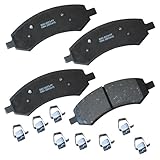

How Much Does Brake Pad Replacement Cost?
A typical brake pad replacement runs $150–$500 per axle, with most drivers paying $250–$350 per axle. Replacing both axles together lands at $300–$900 for most vehicles; luxury and performance cars can exceed $1,000 for all four wheels when OEM pads and rotors are required. The total is driven by four variables: pad material (organic vs semi-metallic vs ceramic), rotor condition (resurface vs replace), shop rate, and — often overlooked in quotes — hardware, wear sensors, and EPB retraction.
Typical Cost by Vehicle Category
| Vehicle category | Per axle | Both axles | Labor hours |
|---|---|---|---|
| Economy / compact | $150–$300 | $280–$550 | 1–1.5 hr |
| Mid-size sedan | $180–$350 | $340–$650 | 1–2 hr |
| SUV / crossover | $200–$400 | $380–$750 | 1.5–2.5 hr |
| Truck / large SUV | $250–$500 | $480–$950 | 2–3 hr |
| Luxury / performance | $300–$700+ | $600–$1,400+ | 2–4 hr |
Ranges assume ceramic or semi-metallic pads and rotor work where needed. Vehicles with an electronic parking brake (EPB) add 0.5 hour of labor for retraction; rotor replacement adds 0.5–1 hour per axle. Source: RepairPal model-level estimates, AAA labor data, and Mitchell 1 / ALLDATA labor-time guides.
Cost Breakdown by Component
| Component | Share of total | Typical range |
|---|---|---|
| Brake pads (parts) | 25–40% | $40–$250 |
| Labor | 35–50% | $70–$300 per axle |
| Rotors (if replaced) | 20–45% | $80–$400 per axle |
| Hardware & shims | 5–10% | $15–$60 |
| Wear sensors | 3–8% | $20–$80 |
| Brake fluid top-off / diagnostic | 5–10% | $30–$120 |
Hardware — shims, clips, anti-rattle springs, caliper-pin boots — must be replaced if it is rusted, cracked, missing, or the boots are torn. A shim that has separated is the most common cause of a persistent squeal after a pad change.
Brake Pad Materials — Cost and Trade-offs
| Material | Parts cost | Behavior | Rotor compatibility |
|---|---|---|---|
| Organic | $30–$70 | Quiet, gentle on rotors, shorter life | Any smooth rotor |
| Semi-metallic | $50–$120 | Better heat handling, noisier, dustier, wears rotors faster | Smooth, drilled, or slotted |
| Ceramic | $70–$180 | Quiet, low dust, longer rotor life, moderate heat | Smooth rotors only — not drilled/slotted |
| Performance / track | $120–$350+ | Extreme heat capacity, high initial bite, dusty, noisy | Matched high-carbon or slotted rotors |
Ceramic pads cost more up front but reduce rotor wear — over two pad cycles the total cost of ownership can be lower than with semi-metallic. Ceramic pads require smooth rotors; pairing them with drilled or slotted rotors causes noise and uneven wear. Semi-metallic pads are the better match for drilled/slotted rotors and for heavy towing.
Brake-Pad Regulations — What Buyers Should Know
Since 2010, California (SB 346) and Washington (SB 6557) have restricted copper and other heavy metals in brake pads; 12 states have now adopted similar rules. The phase-in requires ≤ 5% copper by 2021 and ≤ 0.5% by 2025 for pads sold in those states. Brake pads are also identified by friction coefficient per SAE J866 (a two-letter code such as "FF" or "GG"), and passenger-car brake systems are regulated under FMVSS 135. When buying low-cost pads, confirm the batch meets the copper limits if you are in an adopting state.
Rotors — Resurface or Replace?
| Option | Cost per axle | Pros | Cons |
|---|---|---|---|
| Resurface (only if ≥ min thickness) | $40–$80 | Lower cost | Thins the rotor; not always possible |
| Standard replacement | $80–$250 | New surface, reliable performance | Higher cost |
| Premium (drilled/slotted) | $150–$450 | Better cooling, look, performance | Noisy with ceramic pads; not for all uses |
Every rotor has a minimum thickness stamped on its edge (for example, "MIN TH 22.4 mm"). If the rotor is at or below that thickness, resurfacing is not allowed — it must be replaced. The shop should measure with a micrometer and show you the reading. Resurfacing a rotor that is already at minimum thickness is a safety violation.
How Long Do Brake Pads Last?
| Driving pattern | Typical pad life |
|---|---|
| City / stop-and-go | 30,000–40,000 miles |
| Mixed city / highway | 40,000–60,000 miles |
| Highway commuting | 60,000–70,000+ miles |
| Towing / mountain driving | 20,000–30,000 miles |
| EV / hybrid (regenerative braking) | 80,000–100,000+ miles |
Front pads wear roughly twice as fast as rear pads because they handle most of the stopping force. EVs and hybrids use regenerative braking, which extends pad life dramatically — a factor to consider when comparing quotes.
Labor Rates by Shop Type
| Shop type | Hourly rate | Notes |
|---|---|---|
| Independent shop | $80–$150/hr | Typically the best value for a standard pad-and-rotor job |
| Dealership | $120–$220/hr | OEM pads on hand; scan tools guaranteed compatible |
| Chain / franchise | $100–$180/hr | Coupons common; verify what's included |
| Mobile mechanic | $90–$150/hr + trip fee | Convenient; confirm torque spec and EPB capability |
Electronic Parking Brake (EPB) — the DIY Trap
Vehicles with an electronic parking brake — nearly all 2010+ BMW, Mercedes, Audi, VW, plus many modern Honda, Toyota, Ford, and GM models — require the rear caliper piston to be retracted electronically (not by a C-clamp) before the new pads go in. Without that step, the piston is damaged and a new caliper ($300–$600) is required.
- Some models allow a manual retraction sequence (a sequence of pedal, button, and key presses) documented in the owner's manual or service data.
- Most require an OBD-II scan tool with EPB function — a $200–$1,000+ investment for the DIYer.
- If you cannot perform the retraction step, do not DIY the rear brakes on an EPB vehicle.
Bedding-In New Pads
New pads need a bedding-in procedure to transfer an even layer of friction material onto the rotor surface. Without it, expect persistent squeal, uneven pad wear, or reduced braking performance. Typical procedure (confirm with the pad manufacturer):
- From 30 mph, apply moderate braking to 0 mph. Repeat 20–30 times with a 30-second cool-down between stops.
- Avoid hard stops and heavy braking for the first 200 miles.
- Performance / track pads require a more aggressive procedure — follow the manufacturer's instructions exactly.
- Some OEM European pads specify a burnishing procedure required by regulation; skipping it can result in a noise complaint or a friction-coefficient mismatch.
Warning Signs You Need New Pads
| Symptom | Likely cause |
|---|---|
| Squeal or squeak (often first thing in the morning) | Wear indicator touching the rotor — pads low |
| Grinding metal-on-metal | Pad friction material gone; rotor damage occurring — stop driving |
| Dashboard brake / wear light | Electronic wear sensor triggered |
| Longer stopping distance | Reduced friction |
| Pulsation when braking | Warped rotors or uneven pad deposits |
| Vehicle pulls when braking | Seized caliper or uneven pad wear side-to-side |
| Less than 3 mm of pad material left (visual) | Replacement due |
How to Reduce the Cost
- Bundle pads with rotors: pads + rotors together save one labor cycle (10–20%).
- Use quality aftermarket pads: Akebono (Japanese OEM), Bosch (European OEM), Wagner (domestic), Brembo (performance / European). OEM-equivalent performance at 20–40% less than dealership pricing.
- Choose independent shops: typically 20–35% below dealership labor rates.
- Replace by axle, not by wheel: always both pads on one axle — mixed wear causes pulling and uneven braking.
- Watch for chain coupons: brake-service specials sometimes include pad + rotor resurface.
- Stay on schedule: a $250 pad service now prevents a $600+ rotor and caliper repair later.
Quick Reference — Cost by Vehicle and Axle
| Vehicle | Front only | Rear only | Both axles |
|---|---|---|---|
| Economy / compact | $150–$300 | $130–$250 | $280–$550 |
| Mid-size sedan | $180–$350 | $160–$300 | $340–$650 |
| SUV / crossover | $200–$400 | $180–$350 | $380–$750 |
| Truck / large SUV | $250–$500 | $230–$450 | $480–$950 |
| Luxury / performance | $300–$700+ | $300–$700+ | $600–$1,400+ |
Rear-only prices are slightly lower because rear pads are often smaller, but rear brakes on EPB vehicles add 0.5 hour for retraction. Add rotor work ($80–$400 per axle), hardware ($15–$60), and wear sensors ($20–$80) as applicable. Regional labor rates vary ±15%.
Related Tools
- Brake rotor replacement cost estimator — often done with pads
- Brake fluid replacement cost estimator — a separate service
- Car repair cost estimator — for the broader repair
- Tire patching cost estimator — for related wheel-area work
- Cabin air filter replacement cost estimator — routine maintenance
Frequently Asked Questions (Brake Pad Replacement)
How long does a brake pad replacement take?
1–2 hours per axle for a straightforward pad-and-rotor job. Add 0.5 hour for EPB retraction and 0.5–1 hour if the caliper pins are seized or the hardware is rusted. A front and rear job is usually 2–4 hours. Some shops offer while-you-wait service for straightforward pad swaps.
Do I need to replace rotors when I replace brake pads?
Not always, but often. Rotors must be measured with a micrometer against the minimum thickness stamped on the rotor edge. If they are at or below that thickness, resurfacing is not allowed and replacement is required. On many modern vehicles, rotors are thin enough from the factory that they cannot be safely resurfaced after one pad cycle, so replacement is standard practice.
Can I replace brake pads myself?
Yes on many vehicles, but there are two important exceptions: (1) vehicles with an electronic parking brake require a scan tool or a specific retraction sequence to compress the rear caliper — skip it and you damage the caliper; (2) caliper-mounting hardware must be torqued to the factory specification. A mistake in brake work can be fatal. If either condition applies and you are not confident, use a professional.